 In undertaking my Independent Family Review, I’ve heard from families of all kinds about why family is so important. I wanted to understand why this what, and what we as policy makers could do in response. The importance – and power – of family life is no different for children in the care system, but it is often more complicated to achieve. Children in care are often balancing relationships with birth families, foster families, and hopefully, loving and nurturing relationships with professionals. Within this, it is clear from talking to children in care that sibling relationships are absolutely vital, but too often this is not recognised or supported by the care system. This report seeks to correct this andfocus on extending the protective effect of family to every child in the care system. The Family Review identified how family can cast a protective effect over its members, and that this protective effect was made up of four elements:
The children I speak to, and those who call my Help at Hand helpline, tell me how important these relationships are to them. They talk not just about siblings related by birth, but those such as foster siblings or siblings in blended families, who have become just as close. But the importance of these relationships is not always reflected in the decisions made about children. As one care experienced young person told me: 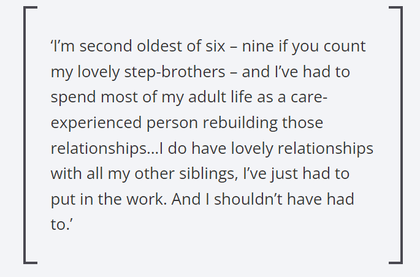 In my conversations with children in care, too often it seems they have to shoulder a weight of responsibility that they shouldn’t have to. I am left with a deep admiration for their resilience and maturity, but a sadness when I think of what they have been through to reach that point.
That is why I have carried out this research looking at the experience of siblings in care and conductednew analysis that shows how many siblings are separated, and why. The findings are stark. An estimated 37% of children with a sibling – that is 20,000 children – are separated from a sibling when placed in care. For some children, the chance of being separated is far greater: 93% of older children placed in semi-independent accommodation are separated from siblings. Children who have come into care because of a disability or because of issues with their behaviour are more likely to be separated than other children. Children told me that too often these decisions were made because there was nowhere available for them to be placed together. When larger groups of siblings were separated, children report beingdivided into groups based simply on age or gender, because it was judged more ‘practical’. These are decisions of immense, life-long importance to children, decisions which may mean they are separated from those people they love the most, being made based on what works for the system, not what is best for the child.If siblings are separated, it is vital that they should be supported to stay in contact with their siblings, so they can maintain these crucial relationships. However, it was clear for from children I spoke to that this is not always happening, particularly when children are in different types of care.This report sets out some clear, practical recommendations that can improve the system for children. I want to see these incorporated into the Government’s plans for improving the children’s social care system. These recommendations are vital for siblings in care, but I also think they will have wider ramifications for children’s social care. Because the challenges in keeping siblings together whenever it is right to do so reflect some of the broader challenges with the system. Sometimes children are separated because they aren’t listened to closely enough, and their priorities aren’t given the weight they should be. Sometimes it is because practice is too varied, with a lack of evidence about what children need. And sometimes it is because the right homes just can’t be found. I believe that with a relentless focus on listening to children, and prioritising their needs, we can build a children’s social care system that allows every child to have the happy family life they so deserve. Source: www.childrenscommissioner.gov.uk Comments are closed.
|
News & JobsNews stories and job vacancies from our member agencies, the fostering sector and the world of child protection and safeguarding as a whole. Browse Categories
All
|

 RSS Feed
|
The Fairer Fostering Partnership
c/o TACT Fostering Innovation House PO Box 137 Blyth NE24 9FJ |